Saturday, 2 February 2013

Uzak

2002 Director Nuri Bilge Ceylan

Set in a wintry Istanbul this film deals with the complexities of urban isolation.

A photographer's ordered life is thrown into turmoil with the arrival of his country cousin seeking employment in the city. Haunted by the feeling that the gap between his life and his ideals is growing, he grows increasingly irritated by his provincial young relative's encroachment into his colourless world.

This is a cinematic delight. Slow pans and long holds allow the viewer to absorb the atmosphere. The progression of the two characters is done through the medium of expression, because, with the exception of one long outburst by the Photographer, dialogue is sparse. The opening sequence is of particular note. Tarkovsky's influence abounds and Ceylan even managed to squeeze an extract of Stalker into the the frame. Seeing Istanbul covered in snow is such an unusual setting and one, I suspect, came about more by luck than planning. A director of fine talent that reminds me of the work produced by Andrei Zvyagintsev.

Thursday, 24 January 2013

Kosmos

2010 Director Keha Erdem

This is Reha Erdem's sixth feature film.  It is a profoundly imaginative and cinematic journey that bursts with philosophical ideas, mystical subplots and truly surreal moments.

A distressed stranger wanders into a snow swept border town where he saves a young boy from drowning. The insular town folk welcome him into their community, but before long they realise that there is more to this stranger than meets the eye. His abstract philosophical musings are his only way of communicating and his reclusive behaviour soon raise suspicions. With the falling to earth of a satellite his situation spirals out of control.

Filmed in Kars, in northern Turkey, in winter conditions, this is a real tour de force and one that marks this director as a visionary creator of films. Is the hero the messiah or just a hapless idiot? I  guess everyone will differ in their interpretation. But this does not detract from the overall effect.


Monday, 21 January 2013

Pusher 3 - I'm the Angel of Death

2005 Director Nicolas Winding Refn

This is third film in Refn's trilogy of Danish underworld dramas and neatly rounds the whole saga up. It plays on exactly the same premise as the previous two giving a different reaction and perspective to similarly laid out scenarios.

This episode follows the path of Milo, the dealer who was present in both the previous episodes. He is struggling to kick his addiction whilst keeping his drug selling activities prosperous. His misfortunes involve a new group of Polish characters who are trying to muscle in on his territory. He too falls foul of a drug deal gone bad, while at the same time, trying to lay on a sumptuous banquet to mark the marriage of his daughter.

There is a good amount of humour in this episode, much of centring around Milo's poor cooking and struggling with the Danish language. This film is not for the squeamish as the violence is extreme, but very matter-of-fact. All in all, this is a coherent study of people dealing with extremely bad circumstances to the best of their abilities. It is directed with a refreshing frankness in a world where there are no heroes nor happy endings.

Friday, 11 January 2013

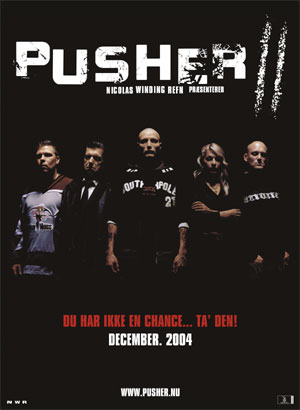
Pusher 2 - With Blood on my Hands

2004 Director Nicolas Winding Refn

This is Nicolas Winding Refn's 2nd foray into the Danish underworld. This time through the eyes of Tonny.

In the first instalment, Tonny was Frank's gormless, sex obsessed side kick, until Frank took a baseball bat to him. Here he returns from prison, more humbled and unsure of himself. He still sports a formidable scar to his head, but that is the only reference to Frank. Tonny sets out to go to work for his father who dabbles in stolen cars. Not before long he finds himself spiralling down the toilet of wastrels, pimps and whores. To complicate matters he finds that while in prison he has become a father. There is a return of Milo the drug supplier, now more portly, as well as other characters from the first episode.

This is a very cleverly made film, once again shot entirely with handheld cameras retaining the same grainy, almost amateur, look of the first film even though they are nine years apart. Mads Mikkelsen plays the part superbly evoking empathy even in the most dire situations. The film has a good deal of pornographic content but this is filmed in such a way as to make the actions sordid and unpleasant rather than erotic. All in all a very good sequel.

Pusher

1996 Director Nicolas Winding Refn

Set in the grimy underbelly of Copenhagen this film tell the story of a drug pusher’s misfortunes with a candid realism that is unusual.

Frank is a gung-ho drug pusher who is lured by a surefire deal. When the deal goes awry he finds himself in debt with his somewhat unforgiving supplier. The more he tries to get out of this dangerous hole the deeper he manages to dig himself in. He is accompnied, helped and hindered by a motley crew of misfits. There are several reference points in this film. The escalating frustration at being thwarted by fate reminded me of Joe Palantino’s role in the Wachowski brother’s “Bound” while the ending is definitely reminiscent of Bob Hoskin’s closing shot in “The Long Good Friday”.

The camera work is all handheld which gives it a documentary feel and the violence is almost matter-of-fact. This film was followed in very similar style some 9 years later by two sequels. Refn did not make the mistake of following Frank's story beyond its natural conclusion, choosing instead to follow the lives of the other two main characters, Tonny, Frank's hapless sidekick and Milo his drug supplier. It all makes very compelling viewing.

Sunday, 14 October 2012

Eden Log

2007 Director Franck Vestiel

This is Vestiel's debut film and an unusual science fiction journey. French cinema is not known for this genre and as such is a bold seminal exploration. The entire film is seen from a single perspective whereby the viewer only sees and knows what the lead character experiences.

Set in a post apocalyptic future, mankind has discovered a new energy source through a tree from which they are able to syphon energy to fuel a city. The denizens below are technicians who are promised paradise when they have completed their work and can return above. Our main character awakens in a confused mud soaked state and embarks on his journey of discovery. Along the way he is given clues as to what has gone wrong by broken machinery, lost transmissions and the revelation of more industrial mayhem. The journey isn’t without its problems.

The most testing element is the modern colour scheme the films makers chose to use in this film. Mostly grey scaled with blue and green colourisation, it is a bit too much to really see past. Even sci-fi films who use this technique give us a break in contrast and slight colour variations. The problem here is that the contrast is too contrasted, so on top of a confused plot, you also are somewhat blinded to everything to be seen. That said, it does engage and even though the ending is reminiscent to Darren Aronofsky's "The Fountain" it does not disappoint.  Although badly received on release I think this film will gain a cult status in time as it is pretty ground breaking in its singular approach.

Sunday, 23 September 2012

Woyzeck

1979 Director Werner Herzog

This film is based on the haunting stage play by Georg Buchner. Klaus Kinski delivers a wild and stunning performance in a role only he could play.  Werner Herzog helmed this cinematization of an anti-military tale of depersonalisation run amok. Utilising the more grotesque elements of German expressionism, combined with his own sense of the outrageous, Herzog plunges us directly into the middle of his story of a soldier who is conditioned to be an unthinking machine. His one vestige of humanity is his love for the beautiful wife, but even this is corrupted.

Franz Woyzeck is a hapless, hopeless soldier, alone and powerless in society, assaulted from all sides by forces he cannot control.  Abused both physically and psychologically by commanding officers, doctors and his unfaithful wife, Woyzeck struggles to hold on to his humanity and his fragile sanity.  In the film's shattering climax, he is finally driven over the brink into madness and murder.

Filmed in the stunningly atmospheric town of Telc, in the Czech republic, its 16th century architecture makes for a visual feast of a backdrop for this rather depressing tale. Kinski's manic energy carries the film and although the ending is at odds with the rest it is still a good example of Herzog at the peak of his career.

Monday, 27 August 2012

Potiche

2010 Director François Ozon

Adapted from a stage comedy by Pierre Barillet and Jean-Pierre Grédy, this film casts a wry eye over the outrageous sexual and political attitudes of the late 1970s and dares to ask whether anything has really changed.

Robert Pujol is the diminutive wrecking ball of right-wing fury who runs his umbrella factory with an iron fist. That is until his surly workforce downs tools and goes on strike and his enemy, pinko local mayor Maurice Babin, is brought in to broker a deal. Under pressure, Robert’s fragile ticker gives up and, as he rests up abroad, his Tinkerbell-like trophy wife Suzanne must take the reins. She injects the ailing business with her own enlightened practices, much to his chagrin.

Simultaneously mocking and revering the look and content of the archetypal ’70s sitcom, ‘Potiche’ succeeds largely due to the fact that all the performers understand the ‘wink-wink’ nature of the material. Ozon evokes the spirit of the era through kitsch, split-screen editing and by filling the soundtrack with old-school Euro chanteurs like Sylvie Vartan and Johnny Hallyday, and even tossing in a bit of Boney M.

It’s as light and soft as a pink satin pillow, and a little overstretched, but it’s also packed with bawdy zingers and pointed political barbs.


Wednesday, 1 August 2012

Nostalghia

1983 Director Andrei Tarkovsky

This is Tarkovsky first film made outside of the Soviet Union just before his defection to the west.

A Russian poet , accompanied by guide and translator, is traveling through Italy researching the life of an 18th century Russian composer. In a ancient spa town, he meets the lunatic Domenico, who years earlier had imprisoned his own family in a barn to save them from the evils of the world. As the guide seeks to tempt him into infidelity, he, seeing some deep truth in Domenico's act, becomes drawn to the lunatic. In a series of dreams, the poet's nostalgia for his homeland and his longing for his wife, his ambivalent feelings for his guide and her Italy, and his sense of kinship with Domenico become intertwined.

With long lingering pans and zooms, this is typical Tarkovsky cinema. His surreal landscapes are meticuously composed and executed. Many of the techniques first seen in Stalker are honed to perfection in the gentle paced exploration of one man's quest for the unobtainable. This is a highly enjoyable visual feast.

Sunday, 29 July 2012

Hell

2011 Director Tim Fehlbaum

This is Tim Fehlbaum filming debut and is a  tightly crafted post-apocalyptic survival tale. The story of a quartet battling marauders while searching for water on a parched Earth of the near-future pays tribute to "Planet of the Apes," "The Hills have Eyes," and "Deliverance".

It's 2016, and the world is a wasteland following a massive spike in global warming. Those who survive are either resourceful or violent, and sometimes both. A motley crew come together in a sun-shielded car heading to the mountains in hopes of finding water.

Fehlbaum shot some scenes in a burned-out forest in Corsica and others in a Bavarian woodland devastated by infestation, and apart from turning the sky a blinding white, he needed very little effects to achieve the right look. Tension is always in the air and the anticipation will appeal to those primed for this sort of material. The actors give their roles the right amount of conviction. A slightly nervous camera maintains the appropriate sense of apprehension, together with rapid editing in climactic moments. Visuals are stripped of color, suitably ashen for a sun-bleached world.