Tuesday, 16 July 2013

The Wind will carry us

1999 Director Abbas Kiarostami

With a strange mission, a group of people from the city come to a small village in Iran. They are awaiting the death of a 100+ year old woman, while pretending to be communication engineers.

A subtle, deceptively simple and richly rewarding work of genius from Kiarostami, this film opens on a long shot of a car negotiating a dusty mountain road, with driver and passengers arguing about where they are. Once the car reaches the Kurdistan village of Siaf Dareh, the ambiguities and mysteries proliferate and interweave. Are the men in the village treasure-hunters, as they tell a boy, the telecom engineers as the villagers assume to be, or something more sinister? Why is their apparent leader curious about the boy's dying grandma? And why, when Tehran calls on his mobile and he needs to move to higher ground, does he always drive to the cemetery, where an invisible man sings from a hole in the ground?

This engrossing and beautiful film succeeds on many levels. As witty, almost absurdist comedy, it offers lovely visual and verbal gags. And as an ethnographic/philosophical study of the relationships between ancient and modern, rural and urban, devotion and directionlessness, it's intriguing and illuminating.

Wednesday, 20 March 2013

Once Upon a Time in Anatolia

2011 Direcor Nuri Bilge Ceylan

Murder mysteries rarely run as deep as this long, dark night of the soul from Turkish filmmaker Nuri Bilge Ceylan. He is a master of brooding stories defined by their wry questioning of human nature and often focused on men in crisis. He has an unflinching eye for the worst in all of us and for the black comedy and absurd banalities of everyday life.

For his sixth film, Ceylan has chosen his bleakest canvas yet: a murder investigation that begins in the dark wilds of the great Anatolian outdoors and ends in the cold light of an autopsy room. In tone, it’s Ceylan’s most epic and talky film yet. But don’t be fooled – it’s also his most mysterious and meditative.We meet a group of a dozen policemen, soldiers and others as they drive about on the steppes one night in search of a body with the two men suspected of burying it. It’s an ensemble piece, and for much of its 158-minute running time, the film itself feels like a painful, fruitless inquiry as it seeks themes, subjects and characters to latch on to. It’s a police procedural, yes, but you imagine that’s just an excuse to bring together a varied group of men in the face of a terrible event. It’s very far indeed from a traditional whodunnit and much more like a compelling, masterly journey.

Saturday, 2 March 2013

The Arrival of Wang

2010 Director Antinio Manetti

This is a remarkable low budget Science fiction film from Italy, that is not exactly known for this genre. Set almost entirely in one room this could easily be a play.

An interpreter based in Rome, whose speciality is Mandarin Chinese gets a call about a very highly paid but mysterious job for a government agency. The money is too good to turn down, so within 20 minutes she is in a car wearing a blindfold being whisked away to a secret location. She is to work with an investigator translating his questions during the interrogation of a suspect. Such is the secrecy of the operation that the interrogation is to be conducted in darkness so Gaia cannot see the subject Senior Wang. She does not know what Wang is accused of, she does not know what agency Curti works for, and as the interview progresses she suddenly finds herself way out of her depth. Ultimately she is moved to seize an opportunity to take matters into her own hands leading to an ending which has a sting in the tail.

The Manetti Brothers’ The Arrival of Wang presents a challenge for a reviewer. The film has a central conceit that it is probably better not to know too much about. Francesca Cuttica is very good in the film as she has to carry the bulk of it, and does so admirably. Yes, the lack of budget shows and there are tacky moments, but as an overall experience I was both fascinated and surprised by the outcome.

Monday, 18 February 2013

Valerie and Her Week of Wonders

1970 Director Jaromil Jires

Take Ingmar Berman's Seventh Veil mix it with Fellini's Amacord and have Andy Warhol direct it and you get this curious Czechoslovakian time piece. Although it contains much that is surreal it is not a surrealist film. It contains much that is gothic yet it is not a horror film. It contains much that is allegorical yet is not an allegory.

It charts the early passage of a girl from pre-pubescence to womanhood from her first period through a series of dreams and visions and her interpretations of others. Since Valerie is in shot the whole time, the film is definitely purely subjective and this would account for characters having multiple roles and incarnations. The motivation is overtly sexual in nature without becoming explicit, while her reactions are almost ambivalent.

Bearing in mind that this was produced in the early days of a communist regime it is a bold and intriguing film. There is much that irritates; some very stilted if not stiff acting, some very obvious continuity breaks, some very poor choreography. Yet there is a certain naive charm and fascination that comes some days after watching it. I think it is a small lost gem. There has certainly never been anything like it since.


Saturday, 2 February 2013

Uzak

2002 Director Nuri Bilge Ceylan

Set in a wintry Istanbul this film deals with the complexities of urban isolation.

A photographer's ordered life is thrown into turmoil with the arrival of his country cousin seeking employment in the city. Haunted by the feeling that the gap between his life and his ideals is growing, he grows increasingly irritated by his provincial young relative's encroachment into his colourless world.

This is a cinematic delight. Slow pans and long holds allow the viewer to absorb the atmosphere. The progression of the two characters is done through the medium of expression, because, with the exception of one long outburst by the Photographer, dialogue is sparse. The opening sequence is of particular note. Tarkovsky's influence abounds and Ceylan even managed to squeeze an extract of Stalker into the the frame. Seeing Istanbul covered in snow is such an unusual setting and one, I suspect, came about more by luck than planning. A director of fine talent that reminds me of the work produced by Andrei Zvyagintsev.

Thursday, 24 January 2013

Kosmos

2010 Director Keha Erdem

This is Reha Erdem's sixth feature film.  It is a profoundly imaginative and cinematic journey that bursts with philosophical ideas, mystical subplots and truly surreal moments.

A distressed stranger wanders into a snow swept border town where he saves a young boy from drowning. The insular town folk welcome him into their community, but before long they realise that there is more to this stranger than meets the eye. His abstract philosophical musings are his only way of communicating and his reclusive behaviour soon raise suspicions. With the falling to earth of a satellite his situation spirals out of control.

Filmed in Kars, in northern Turkey, in winter conditions, this is a real tour de force and one that marks this director as a visionary creator of films. Is the hero the messiah or just a hapless idiot? I  guess everyone will differ in their interpretation. But this does not detract from the overall effect.


Monday, 21 January 2013

Pusher 3 - I'm the Angel of Death

2005 Director Nicolas Winding Refn

This is third film in Refn's trilogy of Danish underworld dramas and neatly rounds the whole saga up. It plays on exactly the same premise as the previous two giving a different reaction and perspective to similarly laid out scenarios.

This episode follows the path of Milo, the dealer who was present in both the previous episodes. He is struggling to kick his addiction whilst keeping his drug selling activities prosperous. His misfortunes involve a new group of Polish characters who are trying to muscle in on his territory. He too falls foul of a drug deal gone bad, while at the same time, trying to lay on a sumptuous banquet to mark the marriage of his daughter.

There is a good amount of humour in this episode, much of centring around Milo's poor cooking and struggling with the Danish language. This film is not for the squeamish as the violence is extreme, but very matter-of-fact. All in all, this is a coherent study of people dealing with extremely bad circumstances to the best of their abilities. It is directed with a refreshing frankness in a world where there are no heroes nor happy endings.

Friday, 11 January 2013

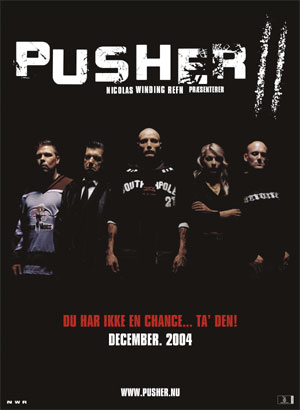
Pusher 2 - With Blood on my Hands

2004 Director Nicolas Winding Refn

This is Nicolas Winding Refn's 2nd foray into the Danish underworld. This time through the eyes of Tonny.

In the first instalment, Tonny was Frank's gormless, sex obsessed side kick, until Frank took a baseball bat to him. Here he returns from prison, more humbled and unsure of himself. He still sports a formidable scar to his head, but that is the only reference to Frank. Tonny sets out to go to work for his father who dabbles in stolen cars. Not before long he finds himself spiralling down the toilet of wastrels, pimps and whores. To complicate matters he finds that while in prison he has become a father. There is a return of Milo the drug supplier, now more portly, as well as other characters from the first episode.

This is a very cleverly made film, once again shot entirely with handheld cameras retaining the same grainy, almost amateur, look of the first film even though they are nine years apart. Mads Mikkelsen plays the part superbly evoking empathy even in the most dire situations. The film has a good deal of pornographic content but this is filmed in such a way as to make the actions sordid and unpleasant rather than erotic. All in all a very good sequel.

Pusher

1996 Director Nicolas Winding Refn

Set in the grimy underbelly of Copenhagen this film tell the story of a drug pusher’s misfortunes with a candid realism that is unusual.

Frank is a gung-ho drug pusher who is lured by a surefire deal. When the deal goes awry he finds himself in debt with his somewhat unforgiving supplier. The more he tries to get out of this dangerous hole the deeper he manages to dig himself in. He is accompnied, helped and hindered by a motley crew of misfits. There are several reference points in this film. The escalating frustration at being thwarted by fate reminded me of Joe Palantino’s role in the Wachowski brother’s “Bound” while the ending is definitely reminiscent of Bob Hoskin’s closing shot in “The Long Good Friday”.

The camera work is all handheld which gives it a documentary feel and the violence is almost matter-of-fact. This film was followed in very similar style some 9 years later by two sequels. Refn did not make the mistake of following Frank's story beyond its natural conclusion, choosing instead to follow the lives of the other two main characters, Tonny, Frank's hapless sidekick and Milo his drug supplier. It all makes very compelling viewing.

Sunday, 14 October 2012

Eden Log

2007 Director Franck Vestiel

This is Vestiel's debut film and an unusual science fiction journey. French cinema is not known for this genre and as such is a bold seminal exploration. The entire film is seen from a single perspective whereby the viewer only sees and knows what the lead character experiences.

Set in a post apocalyptic future, mankind has discovered a new energy source through a tree from which they are able to syphon energy to fuel a city. The denizens below are technicians who are promised paradise when they have completed their work and can return above. Our main character awakens in a confused mud soaked state and embarks on his journey of discovery. Along the way he is given clues as to what has gone wrong by broken machinery, lost transmissions and the revelation of more industrial mayhem. The journey isn’t without its problems.

The most testing element is the modern colour scheme the films makers chose to use in this film. Mostly grey scaled with blue and green colourisation, it is a bit too much to really see past. Even sci-fi films who use this technique give us a break in contrast and slight colour variations. The problem here is that the contrast is too contrasted, so on top of a confused plot, you also are somewhat blinded to everything to be seen. That said, it does engage and even though the ending is reminiscent to Darren Aronofsky's "The Fountain" it does not disappoint.  Although badly received on release I think this film will gain a cult status in time as it is pretty ground breaking in its singular approach.