Showing posts with label 1950. Show all posts

Tuesday, 7 June 2011

Mon Oncle

1958 Director Jacques Tati

This is Tati's second Hulot film contrasting the emerging ultra-modern wave of the late 50's with the more sedate and shambolic life he is used to.
This time, the story finds Hulot on a constant collision with the physical world. Visiting his sister and brother-in-law in their ultra-progressive household full of noisy gadgets and futuristic decor, Hulot inevitably has dust-ups with modernity, each one exceptionally funny. Taking a page from Buster Keaton’s playbook, Tati also employs his trademark techniques with sound and production design to achieve the indefinable, comic genius of his films: the rhythmic clacking of footsteps, the cartoon-panel distance of his camera frame from the heart of the action.

This is a wonderfully gentle satire on modern development that Tati was to take to a darker stage in his next film Playtime. This is marked a departure from his previous more gentle looks at rural attitudes. Tati is one of the cinema’s great treasures, and this movie is unforgettable.

Tuesday, 5 April 2011

Le Ballon Rouge

1956 Director Albert Lamorisse

Most of Albert Lamorisse's films celebrate the miracle of flight, but few were as landmark as his 1956 short subject The Red Balloon. This is a truly delightful gem.

The story, told with a minimum of dialogue, concerns a little boy, played by the director's son Pascal, who comes across a helium-filled balloon. As he plays with his new acquisition, the boy discovers that the balloon seemingly has a mind of its own. The little red orb follows its new "master" all through the streets of Paris, then dogs the boy's trail into the schoolroom, which drives the teacher to comic distraction. Towards the end, it seems as though boy and balloon will be parted forever, but director Lamorisse has a delightful surprise in store for us.

This film serves as a color record of the Belleville area of Paris which had fallen into decay by the 1960s and was eventually demolished as a slum-clearance effort. Part of the site was built up with housing projects; the remainder was left as wasteland for 20 years. Ninety-five percent of what is seen in the film exists no more: the bakeries, the famous Y-shaped staircase situated just beyond the equally famous cafĂ© "Au Repos de la Montagne", the long-gone steep steps of the rue Vilin where Pascal finds the balloon initially and the waste ground where all the battles took place. Only the church of Notre-Dame de la Croix, between the Place Maurice Chevalier and the Place de MĂ©nilmontant remains.

It won numerous awards, including an Oscar for Lamorisse for writing the best original screenplay in 1956 and the Palme d'Or for short films at Cannes. The film also became popular with children and educators.

Friday, 1 April 2011

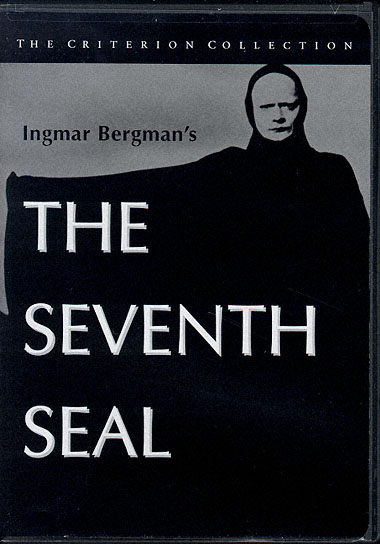
The Seventh Seal

1957 Director Ingmar Bergman

This film launched the international career of its director, Ingmar Bergman, and made a star of its 27 year old leading actor, Max Von Sydow. Endlessly imitated and parodied, this landmark film retains its ability to hold an audience spellbound.

A 14th century knight is wearily heading home after ten years' worth of combat. Disillusioned by unending war, plague, and misery he has concluded that God does not exist. As he trudges across the wilderness, he is visited by Death, garbed in the traditional black robe. Unwilling to give up the ghost, he challenges Death to a game of chess. If he wins, he lives, if not, he'll allow Death to claim him. As they play, the knight and the Grim Reaper get into a spirited discussion over whether or not God exists. To recount all that happens next would diminish the impact of the film itself. The Seventh Seal ends with one of the most indelible of all of Bergman's cinematic images: the near-silhouette "Dance of Death", which ironically was filmed on a whim due to the chance lighting conditions of the moment.

Sixty years later, Bergman's stunning allegory of man's apocalyptic search for meaning remains a textbook on the art of film making and an essential building block in any collection.

Monday, 14 March 2011

Rififi

1955 Director Jules Dassin

Following his expulsion from America during the years of the Unamerican Activities hearings Dassin directed this landmark film about a jewellery heist and the consequences of unfettered greed.

A quartet of thieves band together to commit a seemingly impossible robbery of an English jewelry shop in the Rue de Rivoli. Dassin takes one of the parts as a safe cracker under the pseudonym of Perlo Vita. The heist is meticulously planned and successfully executed but things start to go wrong when a rival gang wants to take a percentage and kidnap the gang leader's son as leverage.

The set piece of the film is an intricate 28 minute sequence that depicts the robbery in detail all filmed in absolute silence without dialogue or music. The tension that Dassin injects into this sequence is so enthralling that it draws the viewer to the very edge of their seat. Although the misogynistic scenes at the beginning of the film would not be considered "according to Hoyle" in today's times they do not detract from the mastery of this often overlooked gem.

Monday, 28 February 2011

The Wages of Fear

1953 Director Henri-Georges Clouzot

This film earned Henri-Georges Clouzot the reputation as a "French Hitchcock." In truth, Clouzot's ability to sustain suspense may have even exceeded Hitchcock's; when originally released, Wages ran for 155 tension-filled minutes. Based on the much-imitated novel by Georges Arnaud, the film is set in Central America.

The Southern Oil Company suffers a well fire, which can only be put out with the use of high explosives. It offers a bounty to any truck driver who can deliver enough nitroglycerin to do the job. So starts a nail biting trip across some of the most treacherous terrain on earth. Through tense interactions and flashbacks, we become intimately acquainted with the four drivers who sign up for this death-defying mission. The first half of the film slowly, methodically introduces the characters and their motivations. The second half, the drive itself, is a relentless, goosebump-inducing assault on the audience's senses.

This is a quite unique film and one of the first to use multiple languages simultaneously without excuse. Filmed against stunning backdrops and meticulously acted, this is a real treat in the art of suspense. The Wages of Fear was remade by William Friedkin as Sorcerer in 1977.

Sunday, 13 February 2011

Les Vacances de M. Hulot

1953 Director Jacques Tati

The first appearance of Hulot and a masterpiece of gentle slapstick.

Pipe-smoking Monsieur Hulot takes a holiday at a seaside resort where his presence provokes one catastrophe after another.  Tati's wildly funny satire of vacationers determined to enjoy themselves includes a series of precisely choreographed sight gags involving dogs, boats, and firecrackers. 

This is a masterpiece of comic timing and running gags that made Tati famous. It's a delight to watch and captures a gentle, less rushed time, now long forgotten. Many of the participants were local people employed on the spur of the moment. The Hotel still exists unaltered in Saint Marc sur Mer, where this was filmed. In fact, the town erected a statue of Monsieur Hulot on the promenade overlooking the beach where most of the action was filmed. A very fitting tribute to a true cinematic gem.